
Date Posted: 2026-09-09
Seasonal vs. Per-Visit Snow Removal Contracts
When arranging commercial snow removal, one of the first decisions property managers may face is how the service will be priced.
Should you pay a fixed amount for the winter? Or pay each time snow clearing and ice-management services are required?
Both seasonal and per-visit snow removal contracts can work well. The better option depends on the property, the level of service required, budget preferences and how much winter-weather risk each party is prepared to assume.
Understanding the difference can make it easier to compare proposals—and avoid surprises halfway through an Ontario winter.
What Is a Seasonal Snow Removal Contract?
With a seasonal contract, the property owner generally pays an agreed amount for winter maintenance over a defined season.
Instead of receiving a snow-plowing charge after every individual snowfall, much of the cost is established before winter begins.
The exact services included still depend on the contract.
A seasonal agreement might cover:
- Parking-lot plowing
- Drive lanes and entrances
- Snow stacking
- Sidewalk clearing
- Salting or other ice-management services
- Site monitoring
- Specific snowfall depths or service triggers
Some services may be included in the seasonal price while others—such as excessive snow relocation or hauling—may remain additional.
That's why the scope of work is just as important as the pricing model.
Our previous guide on commercial snow removal contracts in Ontario covers the other items property managers should consider when comparing contractors.
What Is a Per-Visit Snow Removal Contract?
With per-visit pricing, the customer pays based on the services performed.
For example, a contractor may charge according to snowfall depth each time a parking lot is plowed.
Ice-control applications may also be billed separately.
Depending on the agreement, pricing could change based on factors such as:
- Snowfall accumulation
- Number of plowing visits
- Type of equipment required
- Salt or deicing applications
- Sidewalk service
- Snow relocation
- Snow hauling
During a relatively mild winter, fewer service events may mean lower overall costs.
During a snowy winter, however, the number of visits—and therefore the total cost—can increase considerably.
The Biggest Difference: Who Carries the Weather Risk?
One useful way to understand the two models is to consider weather risk.
With per-visit pricing, more of that risk remains with the property owner.
A mild winter may result in fewer charges. A severe winter can result in substantially more service and a higher total cost.
With a seasonal agreement, more of the snowfall risk is transferred to the contractor because much of the winter cost has already been established.
That predictability can be attractive to businesses and property managers working within annual operating budgets.
However, a seasonal price isn't simply the contractor guessing how many times it will snow.
The contractor needs to consider historical conditions, property requirements, equipment, labour and the level of service it is committing to provide throughout the season.
Advantages of a Seasonal Snow Contract
More Predictable Budgeting
For many commercial properties, this is the biggest advantage.
A seasonal price makes it easier to establish a winter-maintenance budget without wondering how many invoices a snowy January or February might generate.
That can be particularly useful for:
- Commercial plazas
- Industrial properties
- Condominiums
- Office buildings
- Institutional properties
- Multi-residential properties
Less Focus on Individual Events
With a properly structured seasonal agreement, the relationship can focus more on maintaining the agreed service level throughout the winter rather than the cost of each individual plowing event.
Protection During Snowier Winters
A winter with frequent or heavy snowfall doesn't necessarily produce the same increase in plowing charges that it would under a per-visit arrangement.
However, always review the agreement carefully.
Some seasonal contracts have snowfall caps, exclusions or additional charges once particular conditions are reached.
Potential Disadvantages of a Seasonal Contract
The obvious trade-off appears during a mild winter.
If there are relatively few snow events, a property owner may look back and feel that per-visit pricing would have cost less.
But that's similar to many forms of fixed-price contracting: part of what you're purchasing is cost certainty and contractor capacity, not simply a predetermined number of plowing visits.
It's also important to understand exactly what the seasonal price includes.
Don't assume that salt, sidewalks, snow relocation or hauling are automatically included.
Advantages of Per-Visit Snow Removal
You Pay for Services as They're Required
For properties with flexible requirements, per-visit pricing can be attractive because costs correspond more closely with actual winter activity.
Mild Winters Can Cost Less
If snowfall is limited, fewer service events can mean lower total expenditures.
It Can Work Well for Certain Properties
Not every commercial property requires the same service level.
A property that can tolerate more flexibility may be a reasonable candidate for per-visit service.
Potential Disadvantages of Per-Visit Pricing
Winter Costs Are Less Predictable
Ontario winters don't produce identical snowfall every year.
A property may experience a relatively inexpensive winter followed by a season with frequent snow events and substantially higher costs.
Long Storms Can Generate Multiple Services
A significant storm may require more than one visit.
Commercial properties that need to remain accessible during extended snowfall may require repeated clearing rather than waiting until the storm is completely over.
Property managers should understand how those additional visits are charged.
Ice Management Can Add Considerable Cost
Plowing is only one part of winter maintenance.
Freeze-thaw cycles, freezing rain and refreezing conditions can create a need for deicing even when there hasn't been enough snowfall to plow.
If salt applications are charged separately, they need to be considered when estimating the potential seasonal cost.
Don't Compare Contracts Using Plowing Price Alone
Suppose Contractor A offers a lower per-visit plowing rate than Contractor B.
That doesn't necessarily mean Contractor A will cost less over the winter.
You also need to compare:
- Snowfall-depth pricing
- Number of expected passes
- Salting rates
- Sidewalk service
- Minimum charges
- Snow relocation
- Snow hauling
- Equipment used
- Monitoring
- Documentation
- Emergency response
- Any seasonal limits or caps
The objective is to compare the total service being provided, not one number on the quotation.
What About Salt and Ice Management?
This deserves particular attention.
A contract can be seasonal for snow plowing while ice management is billed separately.
Another contract may include some or all deicing services.
Either structure can work, but property managers need to know which one they're buying.
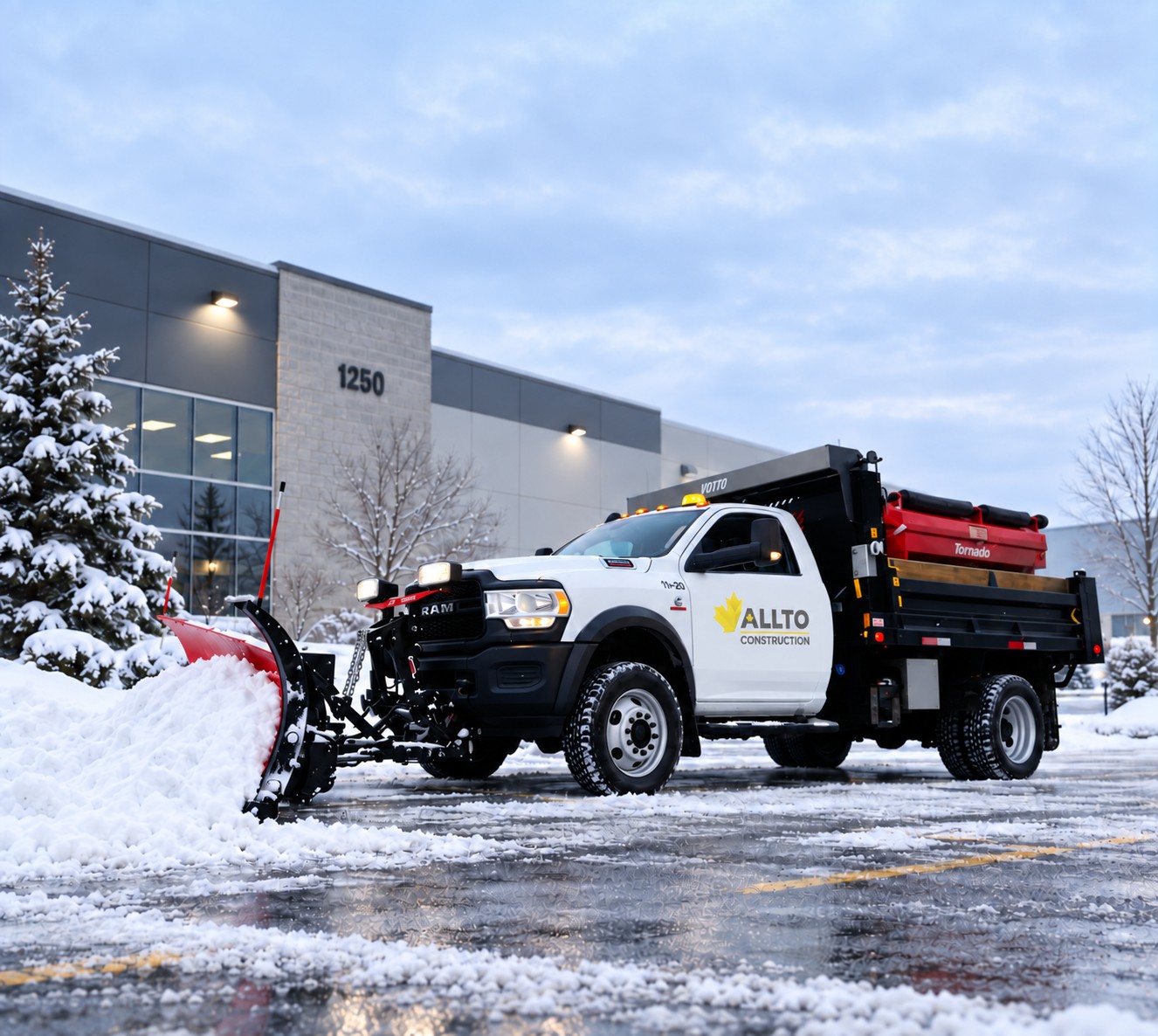
Allto Construction provides commercial snow and ice management with 24/7 winter monitoring and dispatch, and our snow operations include maintained service records.
Our team is also Smart About Salt certified, with an emphasis on effective and responsible salt application.
Learn more about our commercial snow removal and ice-management services.
Consider the Property's Operating Requirements
The right contract structure also depends on how the property operates.
Consider a retail plaza that needs parking lots and entrances accessible early every morning.
Its priorities may be very different from an industrial property that operates only during weekday business hours.
Questions to consider include:
- What hours does the property operate?
- How quickly must the property be cleared?
- Does it operate seven days a week?
- Are there overnight employees?
- Are there frequent deliveries?
- How much pedestrian traffic is there?
- Are there loading docks or fire routes that must remain accessible?
- How much snow can be stored on site?
Those operational requirements should help define the service first.
Then determine the pricing model.
Which Contract Is Better for a Commercial Property?
There isn't one answer for every property.
A seasonal snow contract may make more sense when:
- Budget predictability is important
- The property requires consistent service
- The site has substantial traffic
- Winter accessibility is critical
- Management wants to reduce exposure to year-to-year snowfall variability
A per-visit contract may be worth considering when:
- The property can tolerate greater cost variability
- Service requirements are relatively straightforward
- The customer prefers paying based on individual events
- Management is comfortable assuming more of the weather risk
For larger commercial properties requiring consistent winter maintenance, the decision should ultimately be based on service requirements, risk and total expected cost, rather than simply choosing whichever pricing structure initially appears cheaper.
Start With the Property, Not the Contract
Before deciding between seasonal and per-visit pricing, determine what the property actually needs.
Identify:
- Areas requiring service
- Snowfall triggers
- Operating hours
- Ice-management expectations
- Sidewalk responsibilities
- Snow-storage areas
- Equipment requirements
- Documentation expectations
- Response requirements
Once those expectations are clear, it's much easier to compare proposals properly.
A preseason site walk with the snow contractor can also identify potential problems before they're hidden beneath the first snowfall.
Commercial Snow Removal in Orangeville and South Central Ontario
Allto Construction has provided snow and ice management in Orangeville and surrounding communities for decades.
Our commercial snow operation combines experienced operators, 24/7 winter monitoring and dispatch, service documentation and access to the heavy equipment required to maintain commercial and industrial properties throughout Ontario winters.
If you're reviewing snow-removal options for the coming season, learn more about our commercial snow removal services or contact Allto Construction to discuss your property.
Blog Images
SINCE 1969.